
Shoulder specialist · High-specialty in Bankart, Latarjet & complex instability
Shoulder Instability Surgery in Mexico
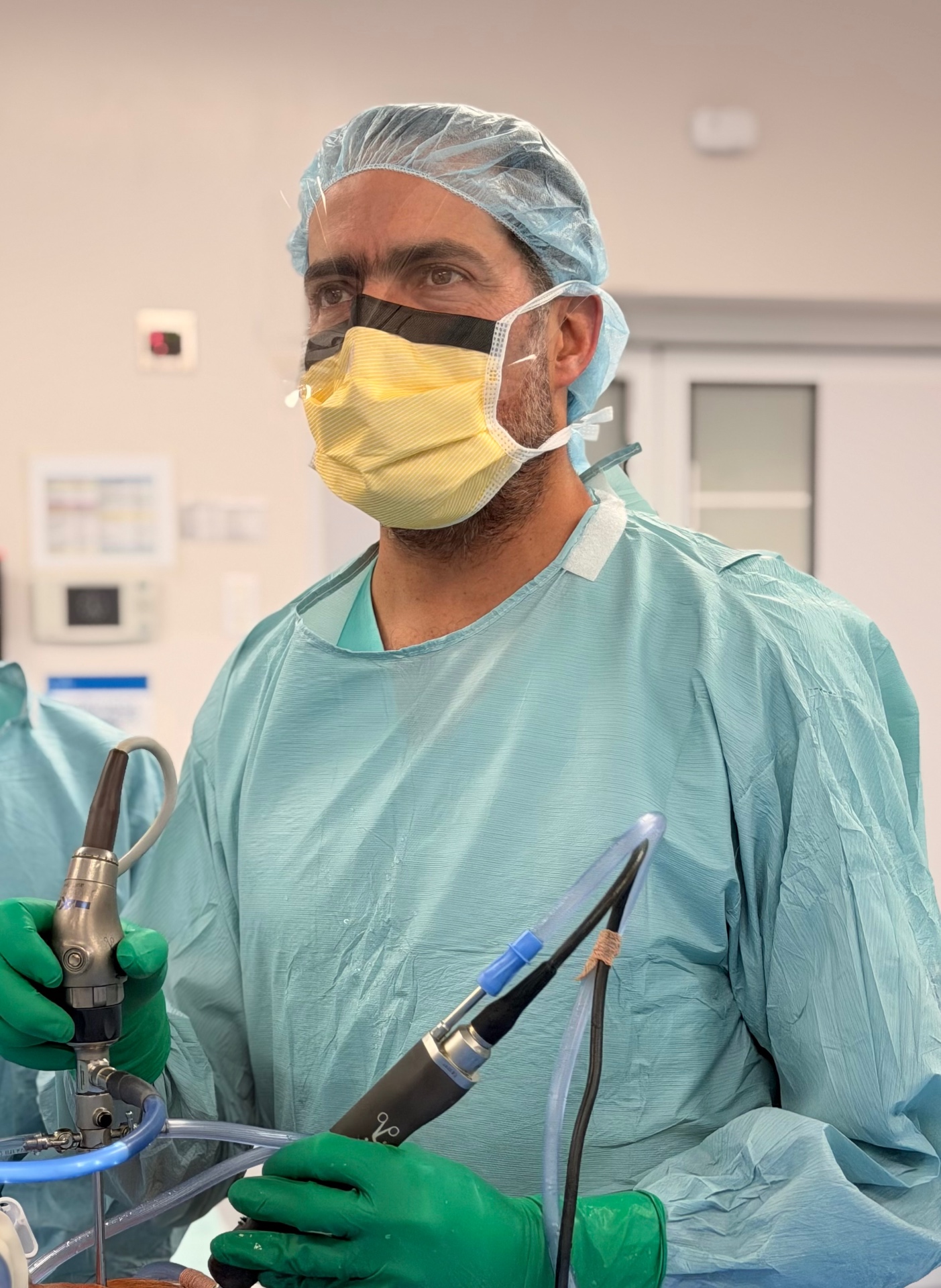
Trained at The Steadman Clinic (Vail, CO) — with an ongoing collaborative relationship with their shoulder team. Arthroscopic Bankart, Latarjet, remplissage and revisions. Getting patients of every age back to the sport they love — including contact and extreme sports.
What are you feeling?
Has your shoulder dislocated — or do you feel it's about to?
Each new dislocation damages more cartilage, labrum and bone — and increases the risk of arthritis. The good news: with the right diagnosis and modern technique, the shoulder can be stabilized and you can return to your sport with confidence.
Symptoms
- Recurrent shoulder dislocations or subluxations
- Sensation that the shoulder slips out with certain movements
- Apprehension lifting the arm overhead or behind the body
- Pain and weakness after a previous dislocation
- Fear of returning to contact, overhead or extreme sports
What is shoulder instability?
When the shoulder loses the structures that keep it in place.
The shoulder is the most mobile joint in the body — and that mobility makes it the most prone to dislocation. Stability depends on the labrum, capsule, ligaments and bone shape of the glenoid and humeral head.
When the shoulder dislocates, it typically tears the labrum (Bankart lesion) and may fracture bone (bony Bankart, Hill-Sachs). These structures rarely heal on their own in young, active patients — recurrence is high. Modern arthroscopic and bone-block techniques restore stability and allow a safe return to sport.
When is surgery needed?
Recurrent dislocations almost always need surgery — and earlier is better.
After a first dislocation in a young, active patient, the recurrence rate can exceed 80%. Each new event damages more tissue and bone, making surgery more complex and recovery longer. The decision is individual — in an honest consultation we evaluate the best option for you.
Surgery is typically indicated for:
- First dislocation in young, active patients (high recurrence risk)
- Recurrent shoulder dislocations or subluxations
- Bankart lesion (labral tear) confirmed on MRI
- Significant bone loss — glenoid (Bankart bony) or humeral (Hill-Sachs)
- Failed prior stabilization (revisions)
- Athletes in contact, overhead or extreme sports who want to return safely
Why choose Dr. Iturbide
Trained at The Steadman Clinic — and still collaborating with their shoulder team today.
Dr. Iturbide completed his primary shoulder fellowship at The Steadman Clinic in Vail, Colorado — recognized worldwide as the leading institution in shoulder and knee surgery. The relationship did not end there: he maintains an active collaborative relationship with the Steadman shoulder surgeons, exchanging cases, complex revisions and the latest techniques in instability surgery. He receives Steadman patient referrals every month.
The Steadman Clinic
Primary fellowship in Vail, Colorado — the world reference in shoulder instability, Bankart, Latarjet and complex revisions. Active, ongoing collaborative relationship with the Steadman shoulder team.
UIC — Chicago, IL
Additional fellowship at the University of Illinois at Chicago in advanced arthroscopic and reconstructive shoulder surgery.
Patients of every age
From elite athletes (Pumas UNAM, Mexican Sailing Federation, Olympians, surfers and skydivers) to active adults — we get patients back to the sports and life they love.
The procedure
The right technique for YOUR shoulder — soft-tissue or bone block.
Every instability case is planned in detail — labral injury, glenoid bone loss, Hill-Sachs, capsular laxity — to choose the technique that gives YOU the lowest recurrence rate. We have high-specialty experience in arthroscopic Bankart, Latarjet, remplissage and revisions.
Detailed evaluation
Clinical examination plus high-resolution MRI and 3D CT to quantify labral injury and bone loss — the key to choosing the right surgery.
Personalized surgical plan
Each shoulder is different. We define the best technique (arthroscopic Bankart, Latarjet, remplissage, capsular shift) based on YOUR anatomy and bone loss.
Arthroscopic Bankart repair
Anatomic re-attachment of the labrum and capsule with knotless suture anchors through 4–5 mm portals — Steadman protocol.
Latarjet procedure
Bone block transfer of the coracoid for cases with significant glenoid bone loss — the gold standard for recurrent instability with bone loss.
Remplissage
Arthroscopic technique to fill engaging Hill-Sachs lesions and prevent re-dislocation — frequently combined with Bankart repair.
Complex & revision cases
Failed prior stabilizations, multidirectional instability and bone-block revisions — high-specialty techniques learned at Steadman.
Treatment of associated injuries
SLAP, biceps, rotator cuff and HAGL lesions — addressed in the same surgery when needed.
Same-day discharge
Most patients go home the same day with a sling — no overnight hospital stay required.
Recovery timeline
A clear, criteria-based path back to your sport — with confidence.
Stabilization recovery requires patience: the labrum or bone block needs time to heal. We follow strength, range of motion, stability and confidence milestones at each phase — never rushed, never delayed.
Sling protection, pain control, gentle pendular and passive range of motion. Protect the repair while soft tissue or bone block heals.
Progressive active range of motion, scapular control, posture work. Sling is gradually discontinued.
Strengthening of cuff and scapular stabilizers. Light functional and gym work begins.
Sport-specific training, throwing progression, gradual return to overhead activities.
Return-to-sport based on objective strength, stability and confidence testing — including contact and extreme sports.
Results
Athletes back on the field. Shoulders that no longer slip out.
of patients return to their previous activity level — including contact and extreme sports — following our protocol.
discharge for the vast majority of cases — no overnight hospital stay.
typical return-to-sport window — based on objective testing, not just calendar.
Patient process
From first call to final return-to-sport.
1. First consultation
We listen to your story, examine your shoulder and review your imaging in detail.
2. Personalized plan
We explain the type of instability, bone loss, options and expected outcomes — clearly and without rushing.
3. Surgery at Centro Médico ABC
Performed at Mexico's leading private hospital, with world-class infrastructure.
4. Guided rehabilitation
We coordinate with elite physical therapists using our own shoulder stabilization protocols.
5. Return to sport & life
Objective testing and final clearance to return to the activity you love — at any age.
Stop your shoulder from dislocating again.
Book a consultation with Dr. Iturbide and get a clear plan to stabilize your shoulder and return to the activity you love — at any age, without doubts and without losing more time.