
Knee specialist · Meniscal preservation philosophy
Meniscus Surgery (Repair & Transplant) in Mexico
Trained at The Steadman Clinic · Advanced arthroscopic surgery. Save-the-meniscus philosophy with modern repair techniques to protect your knee for life — and get you back to the sport you love.
What are you feeling?
Does your knee click, catch or lock?
A meniscal tear can quietly limit your sport and your daily life. The good news: with the right diagnosis, many tears can be repaired — preserving the meniscus and protecting your knee for the future.
Symptoms
- Sharp pain on the inside or outside of the knee
- Clicking, catching or locking
- Swelling that comes and goes
- Pain when squatting, twisting or going down stairs
- Sensation that the knee won't fully straighten
What is the meniscus?
The shock absorber of your knee.
The menisci are two C-shaped fibrocartilage pads (medial and lateral) that sit between the femur and tibia. They cushion impact, distribute load and provide stability and lubrication to the joint.
When a meniscus tears — from twisting, squatting or with degenerative wear — the knee loses cushioning. Removing meniscal tissue accelerates arthritis; that's why modern surgery focuses on REPAIR whenever possible. The meniscus is too valuable to throw away.
When is surgery needed?
Not every meniscal tear needs surgery — but mechanical and repairable ones do.
Many degenerative tears improve with rehabilitation and biologic treatments. Surgery is reserved for tears that lock the knee, that are repairable, or that cause persistent pain. In an honest consultation we evaluate whether surgery is truly the best option for you.
Surgery is typically indicated for:
- Mechanical symptoms: locking or catching of the knee
- Repairable tears (peripheral, vertical, in young patients)
- Bucket-handle tears that block range of motion
- Persistent pain despite rehabilitation and biologic therapy
- Tears associated with ACL injury
- Active patients who want to return to pivoting sports
Why choose Dr. Iturbide
Meniscal preservation expert — trained where modern repair techniques were developed.
The Steadman Clinic
Fellowship in Vail, Colorado — the world reference in meniscal repair, transplant and complex knee surgery.
UIC — Chicago, IL
Additional fellowship at the University of Illinois at Chicago in advanced arthroscopic and reconstructive knee surgery.
Elite athletes
Team physician for Pumas UNAM (6 years), the Mexican Sailing Federation and Olympic athletes.
The procedure
Arthroscopic, preservation-first, individualized.
Every meniscal surgery is planned in detail — tear pattern, repairability, associated injuries — to maximize healing and protect your knee for the long run.
Detailed evaluation
Clinical examination plus high-resolution MRI to define tear pattern, location and reparability.
Save the meniscus first
Whenever the tear is repairable, we repair — preserving meniscal tissue prevents future arthritis.
Minimally invasive arthroscopy
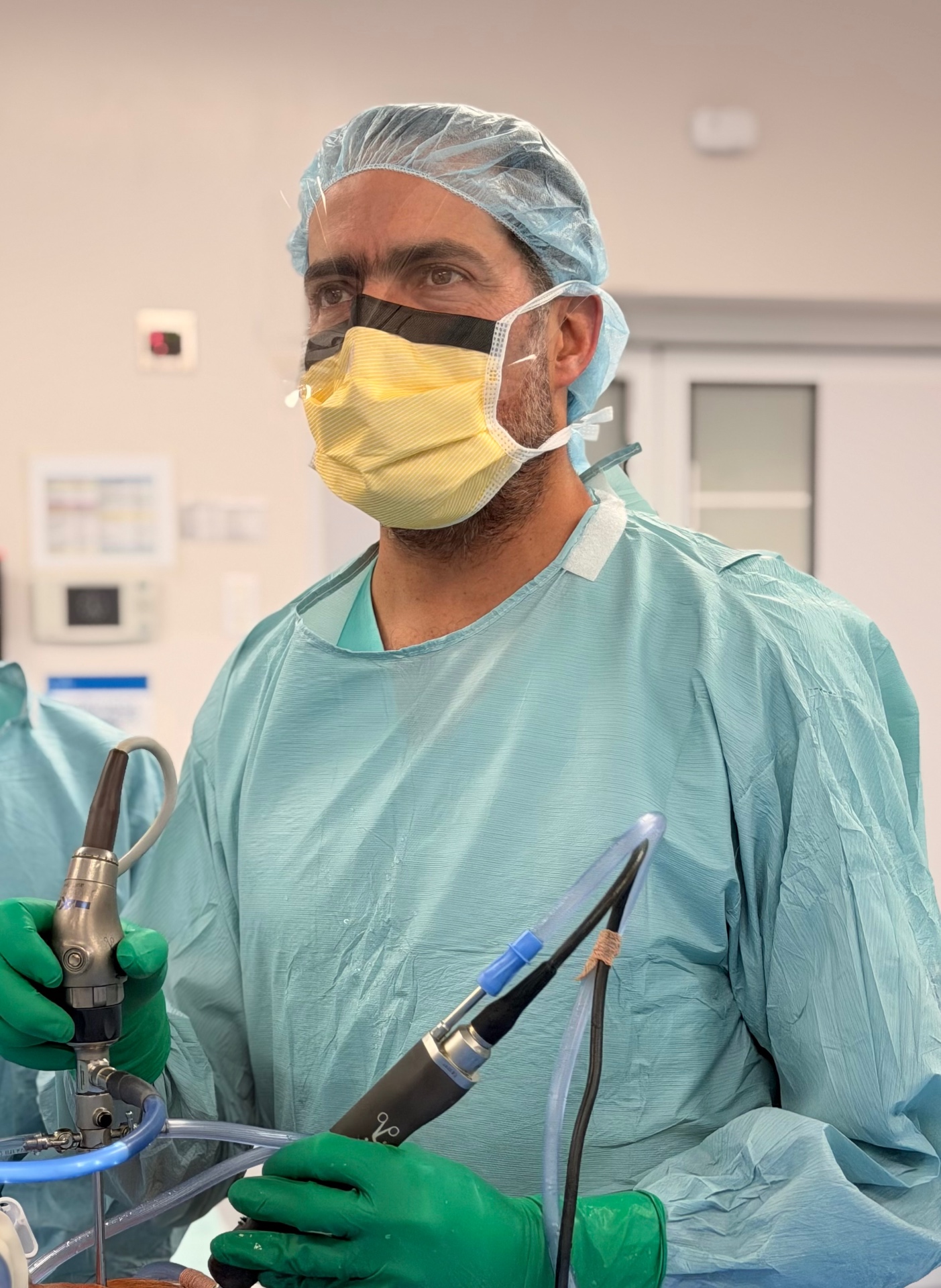
The procedure is done through 2–3 small portals with high-definition camera and Steadman-protocol instrumentation.
All-inside / inside-out repair
Modern suture techniques (FastFix, all-inside) for stable, anatomic healing of the meniscus.
Selective meniscectomy when needed
If the tissue truly cannot be saved, we remove only the unstable fragment — preserving as much meniscus as possible.
Meniscal transplant
For young patients with prior meniscectomy and ongoing pain, we offer meniscal allograft transplantation.
Biologic augmentation
PRP and biologic adjuncts to enhance healing of the repaired meniscus when indicated.
Same-day discharge
Most patients go home the same day, walking with crutches according to the type of repair.
Recovery timeline
A clear, criteria-based path back to your sport.
Recovery depends on whether the meniscus was repaired (slower, protective) or trimmed (faster). Either way, we follow strength, stability and confidence milestones at each phase.
Pain and swelling control, full extension, quadriceps activation. Crutches and brace if a repair was performed.
Progressive range of motion. Repairs: protected weight-bearing. Meniscectomies: walking without crutches in days.
Strengthening, balance, stationary bike and pool work. Progressive removal of restrictions in repairs.
Running progression, plyometrics and sport-specific training (faster after meniscectomy, slower after repair).
Return-to-sport based on objective testing. Repairs typically need 5–9 months; meniscectomies often 6–8 weeks.
Results
Athletes back on the field. Knees protected for life.
healing rate of repaired menisci with modern arthroscopic techniques and rehab protocols.
discharge for the vast majority of cases — no overnight hospital stay.
return-to-sport window depending on whether the meniscus was repaired or trimmed.
Patient process
From first call to final return-to-sport.
1. First consultation
We listen to your story, examine your knee and review your imaging in detail.
2. Personalized plan
We explain the tear pattern, options (repair vs selective meniscectomy vs transplant) and expected outcomes.
3. Surgery at Centro Médico ABC
Performed at Mexico's leading private hospital, with world-class infrastructure.
4. Guided rehabilitation
We coordinate with elite physical therapists using our own meniscal repair protocols.
5. Return to sport
Objective testing and final clearance to return to the activity you love.
Save your meniscus. Protect your knee.
Book a consultation with Dr. Iturbide and get a clear plan to treat your meniscal injury — preserving as much tissue as possible and getting you back to the activity you love.